

The 2012 documentary VAMPIRA AND ME documents the blink-and-you-might-have-missed-it unlikely rise and unfortunate fall of Maila Nurmi — a.k.a. Vampira — a b-movie television hostess in 1950’s California that may well have been the inspiration for countless goth girls that have come after her. Best remembered for all of the wrong reasons — from her performance-under-protest work for Ed Wood in PLAN 9 FROM OUTER SPACE to her failed law suits thirty years with the far-more-successful horror host Cassandra Peterson (a.k.a. Elvira) — Vampira is much more than caricature, costume, or campy comedienne. She is, in many ways, a dark subversive reflection of the seemingly perfect America of the 1950’s, and as such, a figure that should not only be trotted out for Halloween, but be named among breakthrough stars the likes of Lucille Ball (to whom Nurmi oddly enough lost a daytime Emmy).
The documentary tells all, was well reviewed, and is highly recommended. But only hinted at in its exploration of everything from the vagaries of the Hollywood system to the dark side of stalker fans is the suggestion that — with Nurmi’s beatnik roots firmly in place — Vampira was quite a subversive figure for television in 1954 and ’55. Yes, as the documentary makes clear — as does Scott Poole’s biography Vampira: Dark Goddess of Horror (2014) —Vampira, on her velvet sofa, sipping a bubbling cocktail that was “one jigger formaldehyde and two jiggers vulture blood”, was the antithesis of every June Cleaver housewife that had a gin and tonic ready for her husband as he returned from work. But she was much more sinister than that.

Nurmi’s Vampira was not the cheesecake model nor pinup-girl-next-door; those were acceptable images for red-blooded American men to ogle. Instead, she was part of a tradition that, for Nurmi, had its roots in the work of Charles Addams, and, for many a cultural commentator, was part of a long tradition of the vamp in twentieth century culture. She was an outsider, and a potential threat to masculinity.

Long has the male vampire’s victim been a part of the horror movie tradition. In addition to Morticia Addams, Nurmi may have borrowed from the brides in DRACULA (1931). Or perhaps Carrol Borland, the actress who portrayed Luna — the female companion / co-conspirator of Bela Lugosi’s Count Mora in 1935’s MARK OF THE VAMPIRE. But these women are tied to men: the brides, a lover. Morticia, a husband; and Luna, a father.* It’s the makeup. The pose. The presence of these women. The men who helped define them. That was the foundation.
But Vampira was all her own. Though Nurmi was married (her husband had curiously enough come up with the name of the character), Vampira had no male companion. She was the first “vamp” to step off the page or screen and be seen driven about Los Angeles, greeting fans. She would show up as a guest on other television shows, but never as seductress. Always something alien. She was sexy, certainly. But the sex seemed dangerous.

Men were portrayed as scared of her — not attracted to her. A surviving bit of footage from the George Goebel Show has Goebel running away when a date with the strange Vampira (and her literal smoking sofa) starts getting a little too weird for his tastes. A joke, to be sure, but one that has at is base a fear of any woman that doesn’t fit the mold of the ideal, all-american girl. Nurmi’s voice is never flirtatious. Her movements never demure. She is, in fact, threatening, best known for saying “screaming relaxes me” after an ear-piercing shriek that started her every show. Is it a scream of terror? Or ecstasy?
Unlike the over-sexualized Elvira that would follow her years later, Vampira never appeared to be so much an object of desire as one of disturbance to men. Except for her anemic (and silent) turn in Ed Wood’s terrible PLAN 9, Vampira’s presence in footage that has survived always seems to present her as something alien. Whereas men desire Elvira, men are threatened by Vampira. Why? To Vampira, men would appear to be unnecessary.
Cruel then that the surviving image most of us have of Vampira — whether we know the character or not — is that the makeup, clothing and other trappings of the character are labeled “sexy” this and “hot” that on the packaging of many a halloween costume today. It’s almost as if what was once dangerous has been tamed and made to be just another commodity in the 21st century.
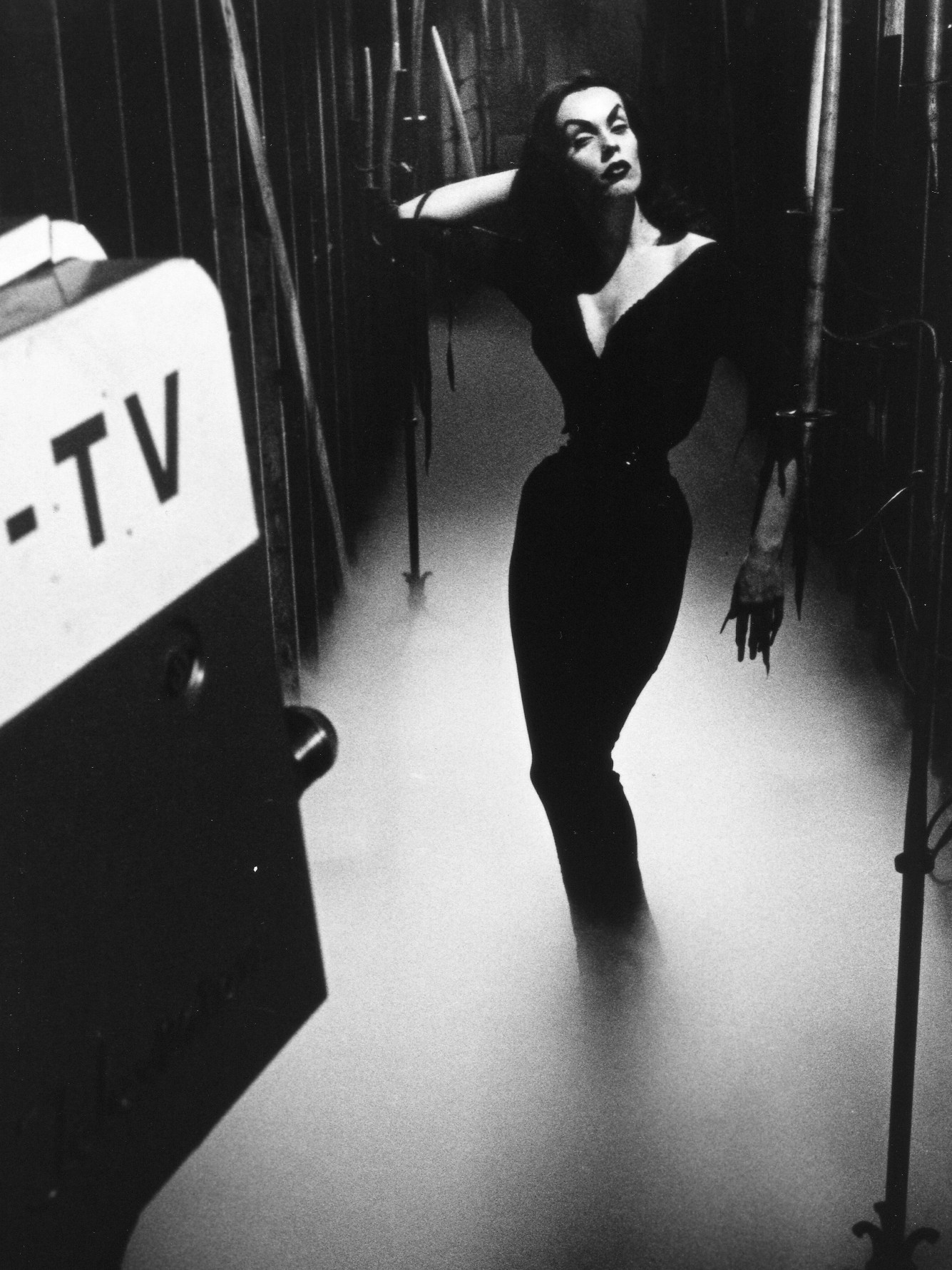 Perhaps this cultural appropriation of the character of Vampira into what is now the fun and fantasy of Halloween is, in some way, exactly what the character should embody: a fantasy, yes, but also nothing out of the ordinary. Subversion succeeds not when it’s on the fringes, but in the homes of millions of otherwise “normal” people. She may be a pose only acceptable on one day a year, but Vampira has found her way into more American homes now than her small Los Angeles television show could ever accomplish in the 1950’s.
She has outlived the June Cleavers of the world.
She survives not as an outsider, but as an icon.
*Dracula’s own daughter, played by Gloria Holden in Universal’s first real sequel in 1936, looked nothing like Vampira, Luna, Morticia or Lily Munster for that matter. DRACULA’S DAUGHTER rightfully deserves its own post about the female monster with no need for men. Possibly the first Lesbian vampire — long before any adaptations of Le Fanu’s Carmilla — Countess Marya Zaleska is more an exercise in psychiatry than it is in vampirism.

