Tag Archives: gothic

Not Goth? Genre Labels and The Sisters of Mercy

Of all genres of rock music, goth is the most difficult to define. Now fully cemented in popular culture with acolytes sporting black clothes, blacker nail polish, and the blackest of lipstick, the movement was not so well defined in the late seventies and early eighties when the term began to be applied (by critics mostly) in the wake of punk.

Coined by rock critic Critic John Stickney long ago in 1967 when describing a Doors show, goth was seemingly first applied to bands most associated with an atmospheric, gloomy, even angular sound late in the nineteen seventies; see, for example, Nick Kent’s “Banshees make the Breakthrough” in his 1978 review of Siouxsie and The Banshees in NME. Indeed, it is Siouxsie and the Banshees, The Cure, Bauhaus, and Joy Division (though the latter never went in for the trappings of goth,  but were labeled as such by their producer, Martin Hannet as in 1979)  that are thought of as the pillars of early goth music.

And then there is The Sisters of Mercy. More specifically, its frontman, Andrew Eldritch, who has famously resisted the goth label — even outright rejected it.

THE BAND
The Sisters of Mercy logo
The Sisters of Mercy logo (from Wikimedia Commons)

Formed in Leeds in 1980, The Sisters of Mercy are known for Eldritch’s melancholic baritone, driving bass lines, sharp guitar riffs, and beats supplied by Doktor Avalanche — a drum machine that has been, for the most part, the only constant member of the band other than Eldritch. At first, only singles and EPs were released from the band. Notable among them is the 12″ single for “Alice,” a lament for a girl addicted to pills. It is on this release that a cover of The Stooges’ “1969” — a staple of the band’s set from the very beginning — appears.

In “1969” is found not only one of the band’s key strengths, but also a possible clue as to the motivations of its members to consciously NOT be goth: that is, a desire to honor a wide range of musical styles with their own distinct sound. Eldritch’s deep, reverb-heavy vocals. The synthetic beats of Docktor Avalanche. Guitars that are mesmerizingly fuzzy. The Sisters of Mercy’s cover of The Stooges’ anthem of dillusion and disaffected youth sounds more like a garage band on amphetamines than it does a gothic rock dirge.

Curiously, The Sisters of Mercy turned out many a colorful cover: Dolly Parton’s “Jolene,” The Rolling Stones’ “Gimme Shelter,” and Hot Chocolate’s “Emma” among them. That these songs are all dark in tone contribute to an understandable goth label, but they are each faithful insofar as Eldrith’s voice allows — and are possibly even  a bit tongue-in-cheek, with the band realizing the unique juxtaposition of music like theirs covering such a wide-range of genres (proto-punk, country, classic rock, even soul).

REJECTING THE LABEL

In an interview in a magazine called Under the Rock — dedicated to all things Sisters of Mercy” — Andrew Eldritch once famously said “I’m not interested in what goths think,” adding that it was journalist David Dorrel from NME who was “a prime originator of the ”Sisters are goth and therefore crap’ smear.” Eldritch went to humourously say “I’m constantly confronted by representatives of popular culture who are far more goth than we, yet I have only to wear black socks to be stigmatised as the demon overlord.”

Still, it’s hard to deny that by the time of their first official album, “First and Last and Always” (1985), songs like “No Time to Cry,” and “Nine While Nine” are hard to describe in any other way than atmospheric and gloomy. “Marian (Version)” alone finds the singer driven along by a quasi-siren song to a watery grave. Yet the apocalyptic “Black Planet” was accompanied by a video that showed the band crusing California on a sunny day in, of all things, the Mokeemobile! If this was goth, its video, at least, eschewed the darker aspects of the band’s image.

Floodland (1987) would find Eldritch developing a more epic sound, full of booming eighties production (e.g., “Dominion / Mother Russia”) and a semblance of pop sensibiltiy on tracks like “This Corrosion” and “Lucretia, My Reflection.”

By the time of the band’s  third album, “Vision Thing” (1990), an all-out hard rock assault is apparent in songs like the titular track, “Detonation Boulevard,” and “More.”

Andrew Eldritch performing with the Sisters of Mercy at Wacken Open Air, 2019 (photo by Sven Mandel [taken from Wikimedia Commons])
Still together (insofar as Eldritch assembles musicians to go out on tour every few years), the Sisters of Mercy have never released a fourth album. Problems with their record company famously turned Eldritch against the industry. Instead, he has focused over the years since on performing live.

After all is said and done with Sisters of Mercy, it is curious to note that practically no early influential post-punks bands particularly like the goth label (see this great reddit post). But why? The simplest answer is that it is reductive, lumping bands with a wide-range of styles into one camp (that is, appropriately enough, often campy). Goth carries a stigma of being a one-trick-pony of sorts: with tired themes and funereal beats. The wide berth given to most other genres is just not open to bands labeled goth.

THE INHERITORS

As for modern goth, the music has splintered further with its labels of death rock, cold wave, dark wave, even ethereal wave.

Bands like Cold Cave, Drab Majesty, and Dark seem to embrace the association of their music with all things sad and scary, morbid and taboo.

In that regard, artists like Andrew Eldritch and his Sisters of Mercy need not even be concerned with labels. The world has moved on. Other artists have picked up the all-black flag (not to be confused with the eighties American Hardcore band) and run with it into the cemetery as the sun sets and the leaves fall.

In the end, it’s all rock and roll, and that’s the landscape where The Sisters of Mercy should ideally find their place. The Cure’s relatively recent induction into the Rock and Roll Hall of Fame has legitimized music (that is fairly or not) labeled goth, and The Sisters of Mercy may one day be judged not by the doom and gloom of their music, but the unique sound that made them stand out from the crowd.

Unmasking the Phantom: Romanticizing the Face of Horror

Phantom of the Opera Mask

Gaston Leroux’s 1910 novel, The Phantom of the Opera, has been filmed at least a half a dozen times, turned into a very successful Andrew Lloyd Webber musical, and used as inspiration for one of the most ubiquitous halloween masks. Behind masks, we hide our true selves. Carl Jung would say those are masks of the persona: the ego adapting to its circumstances. But the physicial mask that hides the horrible, or a face to be pitied (or both)?  That’s unique to Romantic fiction. Especially to the horror genre. And certainly to Phantom of the Opera.

THE NOVEL (1910)

For Leroux, the mask as symbol is quite complex; in addition to having his phantom, Erik, hide a hideous visage, Leroux writes that “none will ever be a true Parisian who has not learned to wear a mask of gaiety over his sorrows and one of sadness, boredom, or indifference over his inward joy.” We are challenged to confront that we all wear masks — not just the ghost of the Opera house that longs for the beautiful Christine. In the gothic tradition to which Leroux’s novel belongs (along with all the adaptations that come later), the masked face is definitely romanticized.

The tale is familiar (well, to people like me it is): Erik hears Christine sing, and is captivated. But he knows himself to be so deformed that Christine will be repulsed by him. So he waits, secretly aiding Christine is her career. Minor characters are literally disposed of, and the main characters eventually find themselves at a pivotal moment when the mask will come off. Hideous boy will stand before beautiful girl, and all will be revealed.

But all what? Disgust? Pity? Overwhelming love?

Here’s where the novel and its many adaptations differ.

In the novel, when Erik is alone with Christine — away from her suitor, Raoul (whom Erik has imprisoned) — he lifts his mask, revealing his deformity, and kisses her on the forehead. She returns his kiss. Erik then reveals that he has never received a kiss — not even from his mother — and is quite overwhelmed with equal parts sadness and joy. He tells Christine that he has never felt so close to another human being, and turns from wicked ways — releasing Raoul. Why? The novel makes it clear: he has been saved by love. Indeed, Leroux has him dying because of love at the end of the novel. Christine buries him, then takes off with the handsome Raoul.

THE SILENT FILM (1925)
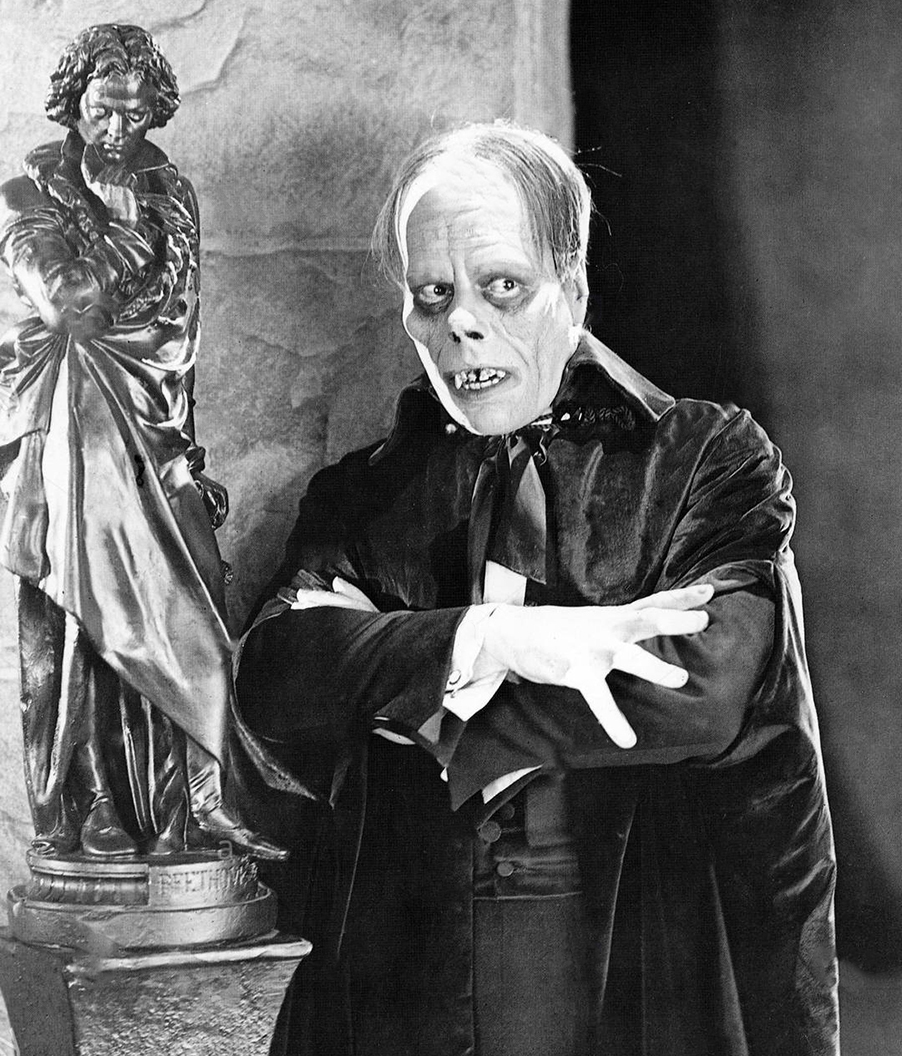
Lon Chaney, The Phantom of the Opera (1925)

Fifteen years later, in 1925, Universal would adapt the novel to the silent silver screen.  Its producer Carl Laemmle (who would later go on to produce both Dracula (1931) and Frankenstein (1931) for Universal), chose Lon Chaney — the man of a thousand faces — for the central role. And in a post World War I world where the horrors of war left mutilated men, it is not beyond reason to assume that Chaney based at least some of his makeup on the poor broken souls who had returned from Europe with faces torn apart by German shrapnel.

Noseless and lipless, with a sunken-eyed face that looks more like a skull than that of a man, Chaney’s phantom goes way beyond the novel with the extent of Erik’s deformity, and it changes the whole tone of the story. Despite Christine still getting the attention from the phantom that leads to he success at the Opera house, her fear — our fear — is real. This phantom illicits horror — or at the very best, our pity. And instead of Erik lifting his mask in an act of love, Chaney’s phantom is dramatically unmasked, by Christine, in one of cinema’s most written-about reveals.

MONSTER OR MISUNDERSTOOD MAN?

Erik’s unmasking is not his own decision. It is sudden. It is terrifying. And it leaves Christine horrified on the floor. A captured Raoul — again, Christine’s suitor — can only be freed if Christine makes a choice of two levers. A challenge is made by Erik. One lever will free Raoul. One will blow up the Opera House. But there’s a catch: free Raoul, and agree to marry Erik.

The tension is palpable. The audience sees Erik as a true monster, and wants so very much for Christine and Raoul to be together. And that is what they get, in a sacrifice made by Erik. He tricks Christine. His intention was apparently to free Raoul all along, and escape the Opera House with Christine. Only he is thwarted by an angry mob who attacks him and throws him into the Seine. Christine and Raoul? They are seen on honeymoon at picture’s end.

Still, the filmmakers initially intended to preserve the original ending of the novel.  They filmed scenes in which Erik dies of a broken heart at his organ after Christine leaves him. But the preview audience apparently hated this ending. They wanted the monster punished, and the lovers to be reunited.

REMAKES AND MIS-TAKES

Throughout the many adaptions — from Claude Rains in 1943, to Herbert Lom in Hamer’s version of 1962, to Brian de Palma’s bizarre Phantom of the Paradise (1974) — the stories change.

Music becomes the true love of the phantom in some. Disfigurement at brith because a tragic encounter with acid in another. But the central theme beneath all is this push and pull between the beautiful chanteuse and the disfigured musician. Sometimes repulsion. Sometimes attraction. Always Romantic in the Gothic novel sense of the term. Except, perhaps, in DePalma’s work, where the Gothic gives way to Glam.

THE MUSICAL (1986 — present day)
Phantom of the Opera musical

But outside of the novel, no version is more romanticized than the Andrew Lloyd Webber musical — which manages to fuse so many elements of the tale told over the last hundred years. In the blending of outcomes, the best and worst case scenarios for poor Erik co-exist. Yes, he is hideous. But he is romantic. And despite Christine’s love for Raoul, there is a bond between her and the phantom — one that often finds its way, as with most musicals, into song — and a gift of a ring to Christine.

The unmasking has mixed reaction — at first fear, but it soon becomes pity. This pity leads to tenderness. And tenderness, to love. At the end, Erik realizes that despite his love for Christine, he must release her to Raoul. The rightful couple begin to escape Erik’s subterranean lair, but not before Christine decides to return the ring that Erik had given her as a token of his love. She finds instead a mob that has descended into the lair to kill the phantom. But as she lifts aside the cloak where she believes Erik to be, she finds only… a mask.

MASKS

Masks play a central role in all adaptations of the Phantom of the Opera. Some are there for sudden horror (kill the monster!). And some are there for romantic imaginings (where did the poor tortured artist go?).

Masque of the Red Death

Some masks are even there to further hide the true persona — or perhaps remind us all that despite love or terror, death awaits us all. In many adaptations, In Lon Chaney’s silent film, Erik attends a ball dressed as Poe’s Red Death. His mask is a skull. Memento Mori. The reminder that life is fleeting, and that we all must die.

In the end, it is the use of the mask — and the unmasking — that addresses our own extremes of attraction and repulsion. And that moment of revelation in the unmasking is truly the most dramatic event in The Phantom of the Opera — be it novel, film, or musical.