Tag Archives: christopher lee

Before Amicus: Milton Subotsky and City of The Dead

Belgian poster for the film, renamed HORROR HOTEL for US and other international audiences

Before Britain’s Amicus Productions was officially formed by Milton Subotsky and Max Rosenberg in 1962, a horror film entitled CITY OF THE DEAD was released in September, 1960. Co-produced with a story by Subotsky, it did poorly at the box office in the UK — even more so in the U.S. where its title was inexplicably changed to HORROR HOTEL. But with its fog smothered sets standing in for a small New England town, and a fine performance by Christopher Lee (along with a talented British cast trying to do American accents), the movie has become something of a cult classic. While it highly sensationalizes the 17th century witchcraft mania in the then American colonies by merging it with bloodthirsty satanists who somewhat comically chant Latin in monks’ robes, CITY OF THE DEAD managers to capture in its lean 78 minutes an entertaining modern gothic — quite different than the better known period pieces of the time made by Hammer or Roger Corman.

Subotsky (who would go on with his  Amicus Productions to produce many famous portmanteau horror films (like TORTURE GARDEN [1967], THE HOUSE THAT DRIPPED BLOOD [1971], and ASYLUM [1972])), grew up in New York City and began his career in television.  He would go on to make the movies ROCK, ROCK, ROCK in 1956 — for which he wrote nine songs! — and another rock n’ roll film, JAMBOREE, in 1959). CITY OF THE DEAD — made after Subotsky moved to England — was thus quite a departure. And it is actually quite a good gothic tale (perhaps the result of his fondness for writers like Robert Bloch  — who actually wrote the three aforementioned Amicus films!).

Subotsky’s knack for spinning a good horror story is really no surprise. A man of many interests — and much energy — he was like a sponge, absorbing so much of the pop-culture (and pulp fiction) of his time. Stars like Lee, Peter Cushing, and Vincent Price all admired him for his dedication to filmmaking (on the cheap!), He undoubtedly had knowledge of the work of other studios at the time (like Hammer), and was known for his tireless efforts to keep many movies in production at once.*bosomed

But CITY OF THE DEAD is quite unlike anything else in Subotsky’s body of work.

Venetia Stevenson
Venetia Stevenson in a promotional still from 1960’s CITY OF THE DEAD (AKA HORROR HOTEL)

The film opens with Nan Barlow (Venetia Stevenson), a student of history in a class taught by Professor Driscoll (Christopher Lee), anxious to learn more about satanism and witchcraft in New England — so much so that she takes her professor’s suggestion to travel to the town of Whitehaven in Massachusets in order to work on a paper exploring the topic. Driscoll recommends that she stay at the Raven’s Inn, an establishment run by Mrs. Newless (Patricia Jessel) — secretly (to all but the audience) the reincarnated witch, Elizabeth Selwyn, who cursed Whitewood, and is the leader of Whitewood’s coven!

Barlow is soon dispatched with on Candlemas Eve, leaving her brother (Denis Lotis), her boyfriend (Tom Taylor) and Whitewood’s antiques dealer, Patricia Russell (Betta St. John) — who had loaned Nan a book on witchcraft to help her with her studies — to solve the mystery of co-ed’s disappearance. Why Russell thinks nothing of this in a mysterious town where her own grandfather, the town’s blind pastor, warns all he can about the lingering evil in Whitehaven is part of the film’s charm. The endless fog and zombie-like townspeople isn’t a giveaway that something is amiss in Whitewood? Suffice to say that Driscoll is (unsurprisingly) revealed to be part of the coven, Newless / Selwyn burns like she was supposed to in 1692, and good triumphs over evil.

The witch Elizabeth Selwyn and dasardly Professor Driscoll (with some third guy) about to offer their sacrifice to Satan.
The witch Elizabeth Selwyn and dastardly Professor Driscoll (with some third guy) about to offer their sacrifice to Satan.

For all of its themes of witchcraft, devil worship, and sacrifices to Satan, CITY OF THE DEAD is a surprisingly tame film. There’s no blood on screen. Unlike PSYCHO (also released in 1960), a descending blade is only shown here for a moment before a humorous cut to a woman slicing up a birthday cake. And unlike many of Hammer’s offerings, there are no big bosomed women in diaphanous gowns. Stevenson, for example, is buttoned up and fully clothed throughout the picture (except for one brief change from a robe into a party dress [exploited by the studio, however, in a famous promotional still for the film]). But even then, it’s only cheesecake. As for gore, there’s very little; the burning witches at the end aren’t much more than lightly charred. And the skeleton at the end? Borderline comical.

It is by no means a groundbreaking piece of filmmaking. Nor particularly unique, as it may be just too much of a coincidence that CITY OF THE DEAD has plot elements similar to three other films released in 1960. There’s a reincarnated witch in Mario Bava’s BLACK SUNDAY. The shadow of a cross burning the undead as in Hammer’s BRIDES OF DRACULA. And the (at first) lead character, an attractive blonde, murdered in the first act just as Janet Leigh’s character is in Alfred Hitchcock’s PSYCHO (based on a novel by Robert Bloch!).

Director Freddie Francis, actor Christopher Lee, and co-producer / writer Milton Subotsky on the set of Amicus’ DR. TERROR’S HOUSE OF HORRORS (1965)

Was Subotsky aware of these other films — each in theaters earlier in the year than CITY’s September release date? It’s impossible to know — not only because we’re not sure what the original script contained and when exactly it was written, but Subotsky had a reputation for being aware of what others were doing, working fast, knowing what sold, using the same actors as other studios, building on existing well-known stories (see Subotsky’s “Wish You Were Here,” a take on “The Monkey’s Paw” in his TALES FROM THE CRYPT (1972)… even recycling sets (as did Corman, Hammer, and many filmmakers, to be fair).

This is not to say Subotsky wasn’t an original. If anything, his approach to making a movie was uniquely his own. And it would serve him well in the horror anthology movies on which Amicus would build its reputation well into the nineteen seventies. His is a story as interesting as Corman’s. His production company more than mere shadow of Hammer. And CITY OF THE DEAD stands on its own as a cult film to be enjoyed and admired.

*Brian McFadden’s book about Amicus is a great read for more on Subotsky and the films he made.

The Living Sun: Dispatching The Undead

Final title card of Nosferatu (1922)

The final scene of F.W. Murnau’s silent masterpiece NOSFERATU (1922), showing Count Orlok being destroyed by the rising sun, may very well be the first time in the history of the vampire — folkloric, literary, or cinematic — that any of the undead (at least in Western culture *) was dispatched by sunlight. His fading away and disappearance into a puff of smoke leads to the film’s final title card, where it is made it clear that “…the shadow of death was gone… as if obliterated by the triumphant rays of the living sun.”

No vampire before Count Orlok expired from exposure to the sun. Lord Ruthven. Varney the Vampire. Carmilla. Even Dracula himself could move about by day. So how did sunlight as a means of dispensing with vampires come to be? Why would NOSFERATU be the first?

The vampire of folklore — particularly during the wave of suspected vampires in Europe in the eighteenth century — always attacked at night. It, and its literary offspring, had to return to their coffins during the day. But death by ultraviolet light? Not part of the mythology. It was most certainly not started by Stoker. His Dracula may be exposed to the rising sun by novel’s end, but his demise is not due to sunlight. He is instead stabbed, and has his throat slit. So the most plausible answer as to why the makers of NOSFERATU introduced death by daylight may be as simple as this: they were looking for a way to clearly finish their film with a scene as far from the ending of the novel as as possible.

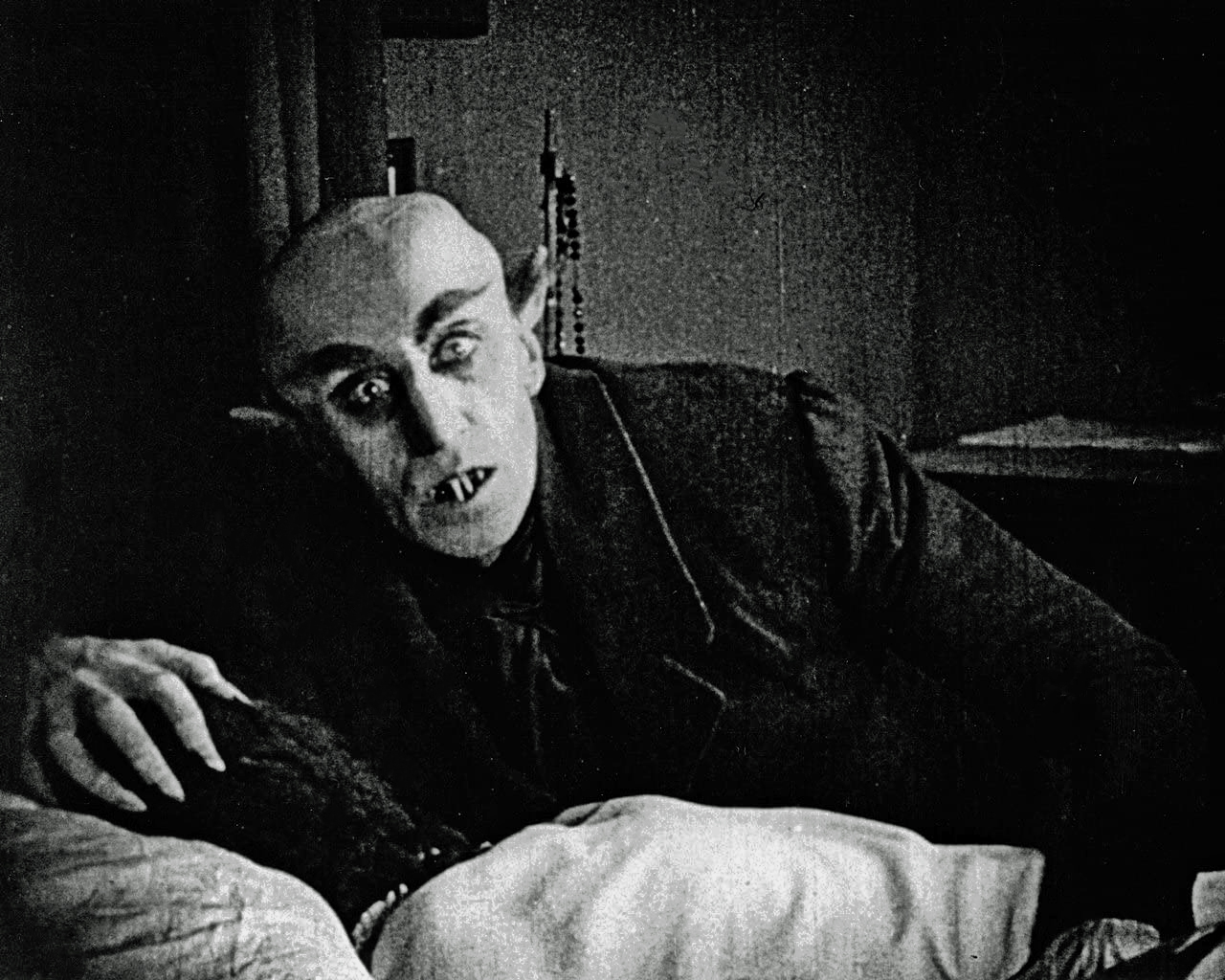
Count Orlok hovers over Ellen Hutter in Nosferatu (1922)

In order to avoid copyright infringement, scriptwriter Henrik Galeen (who later wrote THE STUDENT OF PRAGUE), and director Murnau, veiled their adaptation of Stoker. In their retelling, Count Orlok’s fate would be the direct result of a sacrifice made by the female lead. Ellen Hutter (their Mina Harker) reads from a book that her husband, Thomas (Jonathan Harker), had explicitly told her not to. She learns from it that in order to get rid of the Count, she has to keep him, um, occupied until the cock crows. In the end, it is beauty that kills the beast. Not a cadre of suitors with knives, as in Stoker’s novel.

Stoker’s widow, Florence, still sued, and all prints of the film were ordered to be destroyed (with the final ruling on the case happening in 1925). The filmmakers didn’t have a leg to stand on. Producer Albin Grau had previously applied for a license to film the novel, but had been refused by Florence. So he went ahead and made the film anyway. This was on record, and it lost them the case (i.e., they couldn’t feign ignorance). Fortunately, for film enthusiasts, it is believed that one copy survived, and duplicates were secretly made in the years that followed.

It is in those years that followed that we don’t know much of anything about how widely the film was seen, by whom, and what impression it had upon future filmmakers.

What we do know is that in the almost 20 years following NOSFERATU, no vampire films found their fiends reduced to ash in the morning sun. Not Lugosi’s Dracula (impaled off screen).** Not Dreyer’s vampyr (run through with an iron rod). Not even Dracula’s daughter (felled by an arrow).

HERE COMES THE SON
Son of Dracula (1943)

Then comes SON OF DRACULA, Universal’s third movie to feature Dracula, released on November 5, 1943. Starring Lon Chaney, Jr. as the titular Count, SON OF DRACULA has the distinction of being not only the first vampire film to show the bat-to-man transformation of a vampire on-screen, AND the first to show a vampire turning to mist and back again***, it is also the first motion picture with sound to have a vampire die by exposure to the rays of the sun. At least the first that was released.

Though the screenplay is credited to Eric Taylor, SON OF DRACULA is from a story first conceived by Curt Siodmak — he of WOLF MAN fame (1941). In it, Dracula’s portly “son” (spoiler: it’s actually Dracula) goes by the name Alucard (which, with its simple reversal of letters, surprisingly seems to confuse the cast of characters until well into the film). He seduces a southern belle, and takes possesion of a Lousiana plantation before being exposed — figuratively as a vampire — and literally to the rising sun.

Just how much of the story is Curt Siodmak’s is unknown. His brother, Robert, who directed, hated the script, and reputedly fired his brother. Eric Taylor was ultimately credited with the screenplay, and Siodmak with the story. So who actually came up with the idea to have the Alucard killed by the sun?

Evidence would suggest it was Siodmak’s. After all, Siodmak was adept at dreaming up supernatural lore where none eisted before; it was he who introduced much of the werewolf lore we accept as canon today. More importantly, Siodmak grew up in Germany, and was active in the arts. He could very well have seen NOSFERATU when it premiered in March of 1922.

Born Kurt Siodmak in Dresden, in 1902, Curt worked an engineer early in his career, having had a doctorate in mathematics. But his interests, it seemed, were in the arts. He wrote novels, and used his connections in artistic circles to become involved in German cinema of the nineteen twenties. First, he and his wife-to-be Henrietta de Perrot signed on as extras in Fritz Lang’s METROPOLIS (1926). He wrote a number of screenplays in 1929, and even invested royalties from his early novels in the 1930 movie MENSCHEN AM SONNTAG, directed by his brother. His 1931 novel F.P.1 Antwortet Nicht was adapted to film in 1932 (starring Peter Lorre). The list goes on.

Would it be too much of a stretch, then, to believe Siodmak — whose social circles would have included filmmakers — was quite familiar with Murnau’s NOSFERATU? Seeing the vampire killed by sunlight, Siodmak could have taken that idea and banked it for a future where it just might come in handy.

In 1937, Siodmak emigrated to the U.S. for fear of the growing tide of anti-semitism in his homeland. In 1941, he was given his big break in Hollywood, penning the screenplay for THE WOLF MAN. He would go on after SON OF DRACULA to write the screenplay for HOUSE OF FRANKENSTEIN (1944), where Dracula (this time played by John Carradine) also dies in sunlight.

THE RETURN OF THE VAMPIRE

Of course, like most Hollywood stories, this one has a twist. Seven years after its German release and subsequent destruction courtesy of Florence Stoker’s lawsuit, a surviving / duplicated print of NOSFERATU was shown to American audiences on June 3, 1929.

Return of the Vampire (1943)

It is quite possible that a veteran screenwriter named Randall Faye or the younger Griffin Jay (who would go on to write a handful of horror movies, including THE MUMMY’S HAND (1940) and THE MUMMY’S TOMB (1942)) were in the audience for that showing of NOSFERATU. Both are credited with writing THE RETURN OF THE VAMPIRE. In that film, released November 11, 1943, Bela Lugosi’s Armand Tesla is destroyed when a bomb strikes a cemetery, and the rays of the rising sun reduce the vampire to bones.

Armand Tesla Melts in the sun (from Return of the Vampire)

** That SON OF DRACULA and RETURN OF THE VAMPIRE were released only six days apart casts some doubt as to whether Siodmak was the first to ressurect the idea of dispatching the undead with the light of the morning sun. Perhaps Faye or Jaye can be given the credit.

Not knowing whose idea came first, it’s difficult to determine whether it was Alucard or Tesla who was the first of Hollywood vampires to get crispy by light of day. We might never know.

Christopher Lee's Dracula done in by sunlight at the end of HOROR OF DRACULA (1958)
Christopher Lee’s Dracula done in by sunlight at the end of HOROR OF DRACULA (1958)

But what we’re left with in the seventy-five plus years since is a legacy of vampires who die by rays of the sun. From the dramatic death of the Count in Hammer‘s HORROR OF DRACULA, to Anne Rice’s literary dandies, to the ravenous monsters of FROM DUSK TIL DAWN (who actually explode), death by daylight is now permanently part of vampire lore.

You can watch NOSFERATU in full HD quality below.

* There are stories of the Jiangshi from the Qing dynasty in China where this pseudo-vampire / zombie withdraws when the cock crows, but it’s not clear whether sunlight kills them. I suppose one could argue that sunlight didn’t kill Count Orlok either, and that the cock crow at dawn just made him turn to a mist and go away. To live to drink another day.

** The producer of 1931’s Dracula, Carl Laemmle Jr., definitely saw and drew inspiration from Nosferatu, as it was reputedly one of his reasons for wanting to secure the rights from Stoker’s Widow for a Hollywood adaptation (initially to star Lon Chaney). The screenplay, by Garret Fort — based upon the Balderston / Deane stageplay — adds to the broadway production the novel’s (and Nosferatu’s) opening in Translyvania, and  includes the famous scene where Harker cuts his thumb, illiciting a reaction of bloodlust from the Count (a scene taken DIRECTLY from Nosferatu when Hutter similarly cuts his thumb).

Of course, 1931’s Dracula ends as does the stageplay, with Dracula being staked at the end — and not by exposure to sunlight (which I suppose would have been less dramatic and much harder to pull off on stage!) BUT… the Spanish version of Dracula — filmed at the same time — does curiously find the count fearing the morning sun begin to shine into the catacombs of Carfax Abbey. He doesn’t burn up in the sunlight, but does make haste to return to his coffin where (as in the English version) Van Helsing dispatches him with a wooden stake. Would he have been turned to dust in the sun? We’ll never know.

*** Carlos Villarios’ Count arises from a thick smoke in the Spanish version, but there’s no implication he was corporealizing. Just rising!