Tag Archives: vampire

Bad Things Come in Threes: The Weird Sisters (Brides) of Dracula

Greg Hildebrandt's The Harem
Greg Hildebrandt’s gorgeous illustrations for DRACULA include this one entitled “Johathan (sic) dreams of the vampiresses” (Unicorn Publishing, 1985)

That Bram Stoker deliberately chose to put three vampire “brides” in his 1897 novel DRACULA has been written about many times before. Some scholars point to the power of three, finding ancient symbolism in the number, or a mirroring of Lucy Westenra’s three suitors — Holmwood, Morris, and Seward — in the attraction Jonathan Harker feels toward them.  Some even argue that the vampires that tempt Harker represent an inversion of the Holy Trinity. But the reason Stoker chose to have not one, or two, but three female vampires tempt Jonathan Harker may be as simple as this: he worked in the theater. And from theater he took his inspiration.

SISTERS, DAUGHTERS OR BRIDES?

Introduced in the third chapter of DRACULA, the vampire brides, as they have come to be known (but are never mentioned in the novel as such) are referred to in the fourth chapter as “those weird sisters” (from Jonathan Harker’s Journal, June 29). Two are dark (hair presumably?), with “aquiline noses, like the Count.” The other was “fair as fair can be, with great wavy masses of golden hair and eyes like pale sapphires.”

As Leonard Wolf questions in his annotated edition of DRACULA, one wonders if the resemblance to Dracula of the first two suggest they may be related to him (sisters? daughters?). Of the three, the blonde, his apparent favorite, may be his wife. After all, the other two defer to her for right of first bite: “Go on! You are the first,” says one of the dark-haired sisters, “and we shall follow; yours is the right to begin.” Is she Dracula’s wife? Are the others his children? Is the Count a polygamist!

That they are called sisters by Harker (and later in the novel by Van Helsing) is telling. Nowhere in the book are they referred to as brides, though in popular culture, they have become to be known as such. In the taking of blood (or exchange, as when a transfusion of Holmwood’s blood temporarily aids Lucy), perhaps Stoker was suggesting a type of husband / wife relationship. Or a perversion of traditional marriage.

This much is certain: the sexually suggestive aspect of the vampire that may well be born of the repressed fantasies and insecurities of an Irishman writing in the late nineteenth century certainly finds its most open expression of sexuality in the films of the twentieth.

AT THE MOVIES
Dracula's Brides in 1931's Dracula
Pictured from left to right: Geraldine Dvorak, Dorothy Tree, and Cornelia Thaw. From DRACULA (1931)

Filmic versions of the novel definitely suggest Dracula having a sexual relationship with the vampire women. Perhaps it is from the movies that the term “brides” comes. But the vampire women of Todd Browning’s 1931 production aren’t the source. These vampires are entirely uncredited (so I will give them credit here: Geraldine Dvorak, Dorothy Tree, and Cornelia Thaw). They are more ghostly than provocative. Ethereal. Creepy. Sexual in suggestion. But not in action.

In both DRAKULA ISTANBUL’DA (1953) and Hammer’s HORROR OF DRACULA (1958), the sexuality is there, but there are not three vampire women. Only one in each of these adaptations. And neither is called a bride.

Valerie Gaunt, in the latter, is credited only as “Vampire Woman.” And though Hammer would go on to make a sequel entitled BRIDES OF DRACULA (1960) — originally scripted under the more appropriate title “Disciple of Dracula” — there are only two, not three, vampire women: Greta and Gina. Over a decade later, Hammer’s SATANIC RITES OF DRACULA (1973) — though bearing the title COUNT DRACULA AND HIS VAMPIRE BRIDE upon its release in America in 1979 — credits not three but four “vampire girls” (arguably, Joanna Lumley‘s Jessica Van Helsing is meant to be the titular bride).

THE RETURN OF THE BRIDES OF DRACULA
Vampire Brides of COUNT DRACULA (1977)
The Brides — credited as such — of BBC television’s COUNT DRACULA (1977). Susie Hickford, Sue Vanner, and Belinda Meuldijk

Dan Curtis, of Dark Shadows fame, would reinstate the three brides in his made-for-television adaptation of the novel in 1974, with the three vampire women referred to as “vampire wives.” Close, but not exactly brides. Of course, none of them are referred to as “sisters” either. It is not until 1977’s production COUNT DRACULA starring Louis Jordan that we may have the first instance in film or on television where the vampire women are actually credited as “Brides of Dracula.”

The Three Sisters
The Brides of Dracula are referred to as such in BRAM STOKER’S DRACULA (1992). From left to right are actresses Florina Kendrick, Monica Bellucci, and Michaela Bercu

Perhaps more famously, Francis Ford Coppola’s BRAM STOKER’S DRACULA (1992) also refers to the vampire women as brides as the end credits roll. It is in Coppola’s film that the brides are very definitely highly sexualized, and made to appear like women in a harem more than the ghostly figures of earlier productions. Florina Kendrick, Monica Bellucci, and Michaela Bercu are exotic, alluring, and layered deep with eastern-European garb and language.

As for Frank Langella’s turn at the titular Count in Universal’s 1979 “remake,” the vampire women aren’t even there (as it is based upon the Balderston / Deane stageplay).

Dracula with Brides in VAN HELSING (2004)

Fast forward to 2004 and Universal’s attempt at resurrecting its classic monsters in VAN HELSING, and there we find the return of a trio of brides. Taking flight in the form of harpies, they consist of Marishka (Josie Maran), Verona (Silvia Colloca), and Aleera (Elena Anaya), playing much more than mere temptresses. A scene where Van Helsing (Hugh Jackman) and Anna Valerious (Kate Beckinsale) do battle with them in a town square is the highlight of the movie.

STOKER AND THE STAGE

Regardless of how the label “brides” came to be, there’s still the issue of why Stoker chose to call the vampire women “sisters,” or, specifically (for Harker) “weird sisters” in the first place.

Working for the famous actor Henry Irving since 1878, Stoker would have been familiar with his employer’s repertoire ten years on. That year, 1888, saw Irving (who many suggest inspired certain aspects of the character of Dracula) purchase the Lyceum Theater. Among the first of performances was a revival of his Macbeth.

The Weird Sisters of Macbeth
G.J. Bennett, Drinkwater Meadows, W.H. Payne as the witches (1838) from the Folger Shakespeare Library

In Act I, Scene 3, the first of the witches that go one to prophesize Macbeth’s rise and fall, asks of the seocond: “Where hast thou been, sister?”

It may be as simple as that.

[note: the following amazing (to me at least!) revelation has been added in November, 2022, after reading Dacre Stoker’s and Robert Eighteen-Bisang’s edited and annotated version of the novel, released upon its 125th anniversary]

The proof was waiting there all along for Dracula scholars, hiding in a typescript lost for almost a century.

A TYPESCRIPT IS FOUND

As noted by Stoker and Bisang in the 125th Anniversary edition of DRACULA, no copy of the manuscript for the novel was ever found among Bram Stoker’s personal possessions (and notes [100 pages!], now kept by The Rosenbach Museum and Library). It was assumed any complete version of an early draft was lost to time. Until 1997, that is, when a printer’s copy was found on a farm in Pennsylvania.

Titled “The Un-Dead,” the typesecript went to auction at Christie’s. Microsoft’s Paul Allen came to possess it. Scholars were allowed to study it — including Robert Eighteen-Bissang. And in it? The following excised lines from the novel (underlined as in the 125th Anniversary edition), from Harker’s diary, June 29; on the date of his last letter, Harker hopes to never see the Count again:

“I dared not wait to see him return, for I feared to see those weird sisters. How right was Shakespeare, no one would believe that after three hundred years one should see in this fastness of Europe the counterpart of the witches of Macbeth.”

Turns out Bram had originally intended to make it quite clear: his vampire sisters were counterparts of the witches of Macbeth.**

THE POWER OF THREE

As for Shakespeare, he most likely drew his inspiration from  Greek mythology: the Moirae — Lahkesis, Atropos, and Clotho — who dictate the destinies of humankind by spinning, drawing out, and cutting the threads of each life.

None of this is to say that the Greeks, the Bard (inspired by classical literature), or Stoker (inspired by Shakespeare) didn’t on some level make the choice of three women because the number itself holds some sacred or semiotic significance.

Omne trium perfectum. Everything in threes is perfect or whole.

The primary colors.

Brahma, Vishnu, and Shiva.

Father, son, and Holy Ghost.

Life, liberty, and the pursuit of happiness. Veni, vidi, vici.  Stop, drop, and roll.

Sets of three just seem to make sense to us. We’re hard-wired to respond to threes — be they witches of Macbeth, or Stoker’s weird vampire women.

* Update: want to watch a modern re-interpretation of the weird sisters of Dracula? Neil LaBute’s HOUSE OF DARKNESS (2022) is a misogynist’s nightmare with all the trapping of classic gothic horror. It’s a slow-burn, to be sure, that feels more like a stage-play than a movie. And it requires patience, but the dialogue is delicious and the performances are strong with Justin Long as a hapless man named Hapgood who happens upon a woman named Mina (Kate Bosworth) who he sees as a “sure thing” because of her often bold behavior and frank language. But as the tension between them builds, Mina’s sisters show up (Gia Crovatin and Lucy Walters) and Hap gets more than he bargained for.

** Manuscript aside, the argument that Stoker based his vampire women on the witches of MacBeth had long been out there, argued by critics and film historians. But to have it have been in the manuscript all along was a confirmation of what many had only posited as a theory for years.

The Living Sun: Dispatching The Undead

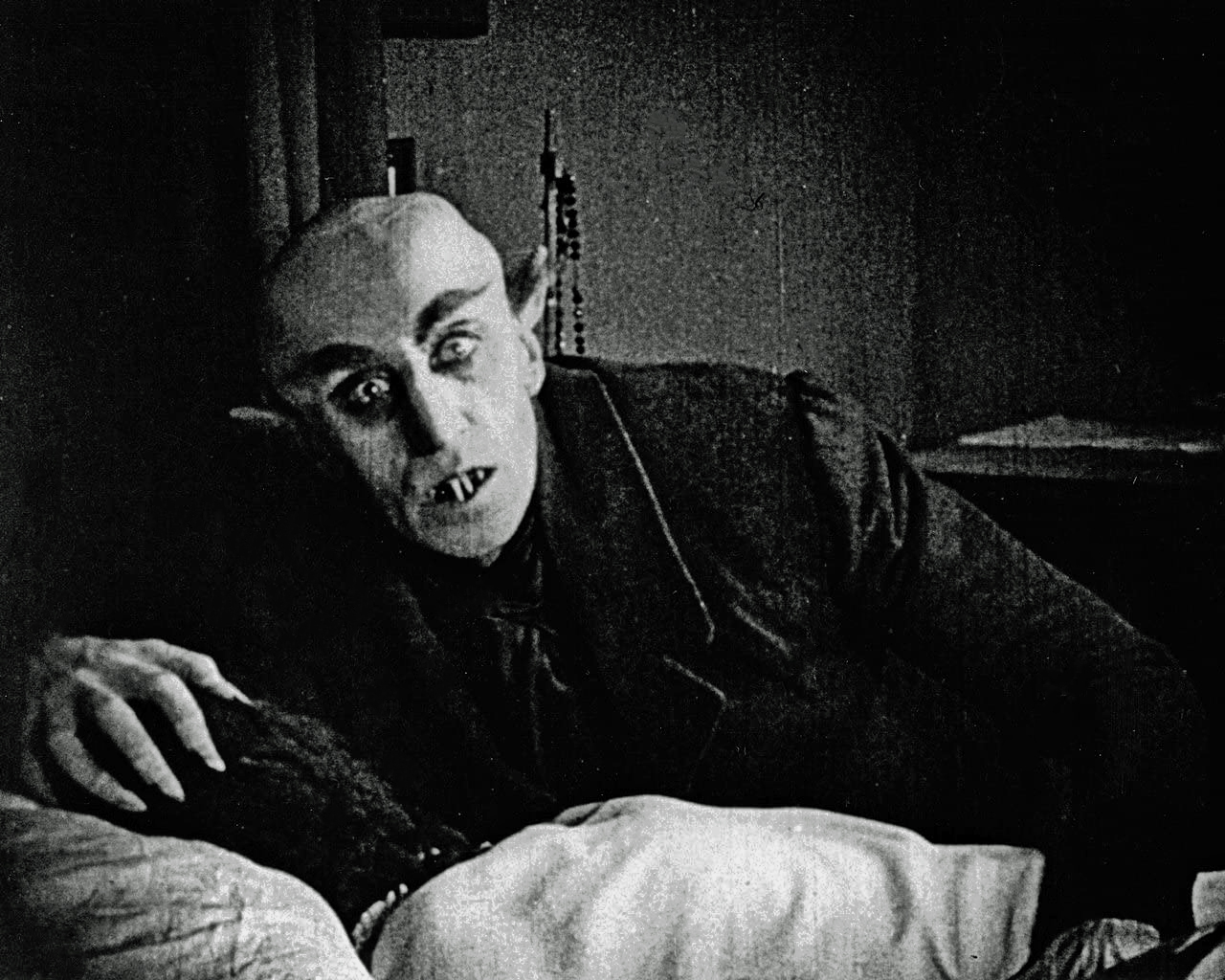
Final title card of Nosferatu (1922)

The final scene of F.W. Murnau’s silent masterpiece NOSFERATU (1922), showing Count Orlok being destroyed by the rising sun, may very well be the first time in the history of the vampire — folkloric, literary, or cinematic — that any of the undead (at least in Western culture *) was dispatched by sunlight. His fading away and disappearance into a puff of smoke leads to the film’s final title card, where it is made it clear that “…the shadow of death was gone… as if obliterated by the triumphant rays of the living sun.”

No vampire before Count Orlok expired from exposure to the sun. Lord Ruthven. Varney the Vampire. Carmilla. Even Dracula himself could move about by day. So how did sunlight as a means of dispensing with vampires come to be? Why would NOSFERATU be the first?

The vampire of folklore — particularly during the wave of suspected vampires in Europe in the eighteenth century — always attacked at night. It, and its literary offspring, had to return to their coffins during the day. But death by ultraviolet light? Not part of the mythology. It was most certainly not started by Stoker. His Dracula may be exposed to the rising sun by novel’s end, but his demise is not due to sunlight. He is instead stabbed, and has his throat slit. So the most plausible answer as to why the makers of NOSFERATU introduced death by daylight may be as simple as this: they were looking for a way to clearly finish their film with a scene as far from the ending of the novel as as possible.

Count Orlok hovers over Ellen Hutter in Nosferatu (1922)

In order to avoid copyright infringement, scriptwriter Henrik Galeen (who later wrote THE STUDENT OF PRAGUE), and director Murnau, veiled their adaptation of Stoker. In their retelling, Count Orlok’s fate would be the direct result of a sacrifice made by the female lead. Ellen Hutter (their Mina Harker) reads from a book that her husband, Thomas (Jonathan Harker), had explicitly told her not to. She learns from it that in order to get rid of the Count, she has to keep him, um, occupied until the cock crows. In the end, it is beauty that kills the beast. Not a cadre of suitors with knives, as in Stoker’s novel.

Stoker’s widow, Florence, still sued, and all prints of the film were ordered to be destroyed (with the final ruling on the case happening in 1925). The filmmakers didn’t have a leg to stand on. Producer Albin Grau had previously applied for a license to film the novel, but had been refused by Florence. So he went ahead and made the film anyway. This was on record, and it lost them the case (i.e., they couldn’t feign ignorance). Fortunately, for film enthusiasts, it is believed that one copy survived, and duplicates were secretly made in the years that followed.

It is in those years that followed that we don’t know much of anything about how widely the film was seen, by whom, and what impression it had upon future filmmakers.

What we do know is that in the almost 20 years following NOSFERATU, no vampire films found their fiends reduced to ash in the morning sun. Not Lugosi’s Dracula (impaled off screen).** Not Dreyer’s vampyr (run through with an iron rod). Not even Dracula’s daughter (felled by an arrow).

HERE COMES THE SON
Son of Dracula (1943)

Then comes SON OF DRACULA, Universal’s third movie to feature Dracula, released on November 5, 1943. Starring Lon Chaney, Jr. as the titular Count, SON OF DRACULA has the distinction of being not only the first vampire film to show the bat-to-man transformation of a vampire on-screen, AND the first to show a vampire turning to mist and back again***, it is also the first motion picture with sound to have a vampire die by exposure to the rays of the sun. At least the first that was released.

Though the screenplay is credited to Eric Taylor, SON OF DRACULA is from a story first conceived by Curt Siodmak — he of WOLF MAN fame (1941). In it, Dracula’s portly “son” (spoiler: it’s actually Dracula) goes by the name Alucard (which, with its simple reversal of letters, surprisingly seems to confuse the cast of characters until well into the film). He seduces a southern belle, and takes possesion of a Lousiana plantation before being exposed — figuratively as a vampire — and literally to the rising sun.

Just how much of the story is Curt Siodmak’s is unknown. His brother, Robert, who directed, hated the script, and reputedly fired his brother. Eric Taylor was ultimately credited with the screenplay, and Siodmak with the story. So who actually came up with the idea to have the Alucard killed by the sun?

Evidence would suggest it was Siodmak’s. After all, Siodmak was adept at dreaming up supernatural lore where none eisted before; it was he who introduced much of the werewolf lore we accept as canon today. More importantly, Siodmak grew up in Germany, and was active in the arts. He could very well have seen NOSFERATU when it premiered in March of 1922.

Born Kurt Siodmak in Dresden, in 1902, Curt worked an engineer early in his career, having had a doctorate in mathematics. But his interests, it seemed, were in the arts. He wrote novels, and used his connections in artistic circles to become involved in German cinema of the nineteen twenties. First, he and his wife-to-be Henrietta de Perrot signed on as extras in Fritz Lang’s METROPOLIS (1926). He wrote a number of screenplays in 1929, and even invested royalties from his early novels in the 1930 movie MENSCHEN AM SONNTAG, directed by his brother. His 1931 novel F.P.1 Antwortet Nicht was adapted to film in 1932 (starring Peter Lorre). The list goes on.

Would it be too much of a stretch, then, to believe Siodmak — whose social circles would have included filmmakers — was quite familiar with Murnau’s NOSFERATU? Seeing the vampire killed by sunlight, Siodmak could have taken that idea and banked it for a future where it just might come in handy.

In 1937, Siodmak emigrated to the U.S. for fear of the growing tide of anti-semitism in his homeland. In 1941, he was given his big break in Hollywood, penning the screenplay for THE WOLF MAN. He would go on after SON OF DRACULA to write the screenplay for HOUSE OF FRANKENSTEIN (1944), where Dracula (this time played by John Carradine) also dies in sunlight.

THE RETURN OF THE VAMPIRE

Of course, like most Hollywood stories, this one has a twist. Seven years after its German release and subsequent destruction courtesy of Florence Stoker’s lawsuit, a surviving / duplicated print of NOSFERATU was shown to American audiences on June 3, 1929.

Return of the Vampire (1943)

It is quite possible that a veteran screenwriter named Randall Faye or the younger Griffin Jay (who would go on to write a handful of horror movies, including THE MUMMY’S HAND (1940) and THE MUMMY’S TOMB (1942)) were in the audience for that showing of NOSFERATU. Both are credited with writing THE RETURN OF THE VAMPIRE. In that film, released November 11, 1943, Bela Lugosi’s Armand Tesla is destroyed when a bomb strikes a cemetery, and the rays of the rising sun reduce the vampire to bones.

Armand Tesla Melts in the sun (from Return of the Vampire)

** That SON OF DRACULA and RETURN OF THE VAMPIRE were released only six days apart casts some doubt as to whether Siodmak was the first to ressurect the idea of dispatching the undead with the light of the morning sun. Perhaps Faye or Jaye can be given the credit.

Not knowing whose idea came first, it’s difficult to determine whether it was Alucard or Tesla who was the first of Hollywood vampires to get crispy by light of day. We might never know.

Christopher Lee's Dracula done in by sunlight at the end of HOROR OF DRACULA (1958)
Christopher Lee’s Dracula done in by sunlight at the end of HOROR OF DRACULA (1958)

But what we’re left with in the seventy-five plus years since is a legacy of vampires who die by rays of the sun. From the dramatic death of the Count in Hammer‘s HORROR OF DRACULA, to Anne Rice’s literary dandies, to the ravenous monsters of FROM DUSK TIL DAWN (who actually explode), death by daylight is now permanently part of vampire lore.

You can watch NOSFERATU in full HD quality below.

* There are stories of the Jiangshi from the Qing dynasty in China where this pseudo-vampire / zombie withdraws when the cock crows, but it’s not clear whether sunlight kills them. I suppose one could argue that sunlight didn’t kill Count Orlok either, and that the cock crow at dawn just made him turn to a mist and go away. To live to drink another day.

** The producer of 1931’s Dracula, Carl Laemmle Jr., definitely saw and drew inspiration from Nosferatu, as it was reputedly one of his reasons for wanting to secure the rights from Stoker’s Widow for a Hollywood adaptation (initially to star Lon Chaney). The screenplay, by Garret Fort — based upon the Balderston / Deane stageplay — adds to the broadway production the novel’s (and Nosferatu’s) opening in Translyvania, and  includes the famous scene where Harker cuts his thumb, illiciting a reaction of bloodlust from the Count (a scene taken DIRECTLY from Nosferatu when Hutter similarly cuts his thumb).

Of course, 1931’s Dracula ends as does the stageplay, with Dracula being staked at the end — and not by exposure to sunlight (which I suppose would have been less dramatic and much harder to pull off on stage!) BUT… the Spanish version of Dracula — filmed at the same time — does curiously find the count fearing the morning sun begin to shine into the catacombs of Carfax Abbey. He doesn’t burn up in the sunlight, but does make haste to return to his coffin where (as in the English version) Van Helsing dispatches him with a wooden stake. Would he have been turned to dust in the sun? We’ll never know.

*** Carlos Villarios’ Count arises from a thick smoke in the Spanish version, but there’s no implication he was corporealizing. Just rising!